Configuring user roles and permissions
NAVIGATION My Account > Account Settings > Permissions
In myITprocess, user roles define responsibilities and permission levels to ensure a smooth, structured workflow across your team. Each user is assigned a role that determines which areas of myITprocess they can access and what level of access they have (that is, no access, a read-only view, or the ability to modify data).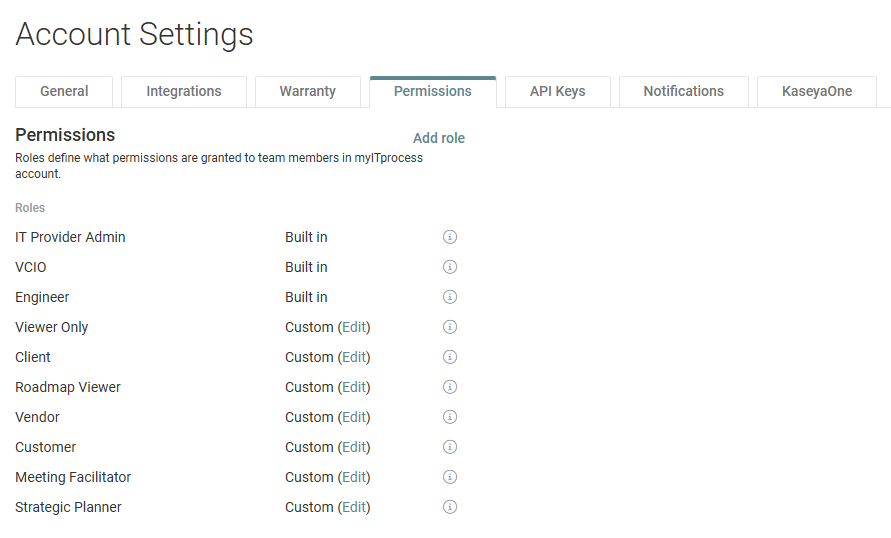
The three built-in roles and any created custom roles are displayed in the Permissions tab on the Account Settings page. Hovering over the info icon  for any role reveals its granular permission details.
Roles are assigned to users from the Users page. After learning how to configure roles in your account settings, proceed to Adding and managing users.
Role types
Built-in roles
The following three roles are available in myITprocess by default and cannot be modified or deleted:
- IT Provider Admin
- vCIO
- Engineer
Expand the following drop-downs for an overview of each built-in role:
 IT Provider Admin
Users assigned the IT Provider Admin role have the highest level of access in the account. Their unrestricted permissions allow for access to all areas of the application and full data modification privileges.
Responsibilities
- Configuring the initial setup of the company's myITprocess account.
- Overseeing the account subscription and license usage.
- Managing users and their roles.
- Managing client environments and generating high-level reports.
- Ensuring the platform is optimized and aligned with organizational goals.
vCIO
Users assigned the vCIO (Virtual Chief Information Officer) role are concerned with the secondary stage of the review process, reports, and creating the Strategic Roadmap for clients. vCIO access is tailored to the strategic layer of the platform, with less emphasis on day-to-day configurations. These users play a strategic role focused on client engagement and long-term planning.
Responsibilities
- Leading client technology review meetings.
- Interpreting assessment results and client needs.
- Creating and managing the Strategic Roadmap that aligns IT initiatives with business goals.
- Producing client-facing reports to communicate value and guide future planning.
Engineer
Users assigned the Engineer role are designated to assess client environments in a strict yes/no format. The Engineer permissions are tailored to optimizing efficiency for this critical role. These users are primarily responsible for conducting clients' technical assessments. Their view is simplified and streamlined, ensuring they can complete assessments quickly and effectively without unnecessary distractions.
Responsibilities
- Answering assessment questions in a structured yes/no format to evaluate compliance and operational standards.
- Focusing on accuracy and efficiency in data collection.
- Collaborating with the vCIO by supplying technical input for roadmap planning.
Built-in role permission breakdown
| IT Provider Admin | vCIO | Engineer | |
|---|---|---|---|
| Overview Report | Full | Full | None |
| Organization Progress | Full | Full | None |
| Alignment Report | Full | Full | None |
| Organizations | Full | Full | None |
| Data of all users' organizations | Full | None | None |
| Manage Roles | Full | None | None |
| Meeting Mode | Full | Full | None |
| Account settings | Full | None | None |
| myITemplates | Full | Full | None |
| QBR Report Builder | Full | Full | None |
| Backup Dashboard | Full | Full | Read-only |
| Review | Full | Full | Full |
| Standards Library | Full | Full | None |
| Strategic Roadmap | Full NOTE Only users with this role can view the last review date and alignment score in the Strategic Roadmap. |
Full | None |
| Users | Full | None | None |
| Subscription management | Full | N/A | N/A |
Custom roles
Custom roles allow you to set individual permissions to one of three access levels: None, Read-only, or Full. Custom roles have custom names, and you can freely add, edit, or delete them.
How to...
Add custom user roles
To create a user role with custom permission levels, complete the following steps:
- In the upper-right corner of the header, click your username (My Account) and select Account Settings.
- Click the Permissions tab.
- Click Add role.
- In the Role Name field, enter a name for the role you are creating.
- By default, all permission levels are set to None. Configure the permission levels for the role as required.
- Click Save to create the role.
NOTE You must change at least one permission from None to another access level.
The new role is now available to assign to users from the Users page. Refer to Adding and managing users.
Edit custom user roles
NOTE The built-in roles (IT Provider Admin, vCIO, and Engineer) cannot be edited.
To edit an existing user role, complete the following steps:
- In the upper-right corner of the header, click your username (My Account) and select Account Settings.
- Click the Permissions tab.
- Click Edit (in parentheses) next to the permission you wish to edit.
- Edit the role name or permission levels as required.
- Click Save.
Delete custom user roles
NOTE The built-in roles (IT Provider Admin, vCIO, and Engineer) cannot be deleted.
To delete a user role, complete the following steps:
- In the upper-right corner of the header, click your username (My Account) and select Account Settings.
- Click the Permissions tab.
- Click Edit (in parentheses) next to the permission you wish to delete.
- In the lower-left corner of the page, click Delete permission role.
NOTE This option is not available if the role is currently assigned to at least one user. To delete a custom role with assigned users, you must assign those users to a different role before proceeding with deletion.


